

The Origins & Legacy of KSDAR
The National Society Daughters of the American Revolution was founded in 1890 by four visionary women dedicated to historic preservation, patriotic service, and educational empowerment. With Kentuckian Mary Desha (1850–1911) among the co-founders, Kentucky formed strong ties to the organization immediately:

-
Early Growth:
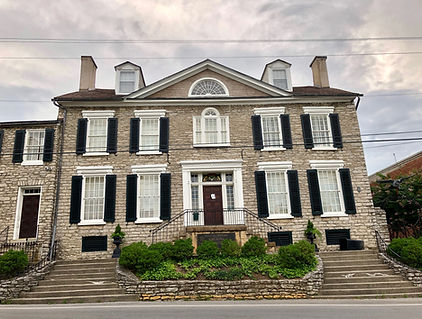
Duncan Tavern Historic Center
-
Historical State Regents:
The Lexington Chapter (Oct 1891) and John Marshall Chapter in Louisville (Jan 1892) were established first. By 1896, with over 10 chapters active, members met in Estill Springs to establish the State Society (KSDAR).
Early leadership included Mrs. Henry (Sallie Ewing) Pope (First State Regent, 1896), Mrs. Anna Maxwell (1896, 1898), and Lucretia Clay—a direct descendant of Henry Clay (1899, 1900).
-
Headquarters & Duncan Tavern:
In 1911, KSDAR furnished the Kentucky Room at NSDAR Headquarters in Washington, D.C. In 1940, the Jemima Johnson Chapter acquired the historic 1790s Duncan Tavern in Paris, Kentucky. Led by Mrs. Julia Ardery, KSDAR restored the building into its official state headquarters, housing a museum and the John Fox, Jr. Library. For more information on visiting this historic location, visit duncantavern.com
Mary Desha
Historic Properties and Showcases

Duncan Tavern Historic Center
Duncan Tavern Historic Center
Located in Paris, Kentucky, this historic treasure was constructed in the mid-1790s by Joseph Duncan. By 1940, the grand structure had fallen into severe decay and was condemned for demolition. The City of Paris offered the building to the Kentucky Daughters for just $1.00, under the condition that they completely renovate it within a single year. Led by Mrs. Julia Ardery, the Daughters rose to the challenge.
Since 1941, Duncan Tavern has proudly served as the KSDAR State Headquarters. Following a massive, multi-year restoration project, it features:
-
A fascinating museum detailing the lives of its early frontier families, furnished with inherited period-accurate antiques, fabrics, and paintings.
-
The premier John Fox, Jr. Genealogy Library and a specialized gift shop.
-
A historic "summer kitchen" fully restored in 2020 by the Jack Jouett Society (Kentucky’s Children of the American Revolution).
Today, Duncan Tavern stands as a prized historic venue for public tours and private events. To plan your visit, learn more at duncantavern.org.
Hindman Settlement School
Founded in 1902 by pioneering Kentucky Daughters May Stone and Katherine Pettit, Hindman Settlement School is one of our five national DAR-supported schools. Located in Knott County, its mission is to provide life-changing education and service opportunities to the people of the Appalachian mountains while honoring their rich cultural heritage. Today, the school addresses the region's most critical needs through dedicated programs for dyslexia, youth literacy, sustainable local farming, and traditional mountain arts.

Hindman Settlement School
The Kentucky Period Room (DAR Museum)
Our national headquarters at DAR Constitution Hall in Washington, D.C., houses the world-renowned DAR Museum. The museum contains over 30,000 American artifacts dating before the Industrial Revolution, displayed across 31 magnificent "period rooms" curated by individual state societies.
The Kentucky Room is masterfully styled to replicate a grand Bluegrass parlor from the 1830–1840 period. Notable features include:
-
A rare, neoclassical sofa upholstered in blue striped horsehair, potentially crafted in the famous New York workshop of Duncan Phyfe.
-
Historic 19th-century engravings by legendary naturalist John James Audubon.
-
A historic engraving of Ashland, the Lexington home of statesman Henry Clay.
-
A 1910 portrait commemorating Revolutionary War hero General George Rogers Clark.
The DAR Museum is open to the public for both self-guided and docent-led tours. Learn more at dar.org/museum.
Kentucky's Historic Legacy in the American Revolution
While the history of the American Revolution often focuses on the original 13 colonies, Kentucky served as a crucial military frontier, witnessing major engagements—including the last major battle at Blue Licks—and the rise of legendary figures Daniel Boone and George Rogers Clark.

George Rogers Clark
George Rogers Clark & The Western Frontier
In 1776, the region known as Fincastle County, Virginia, was divided, creating Kentucky County. George Rogers Clark, representing the region in the Virginia Assembly, secured supplies to defend against British-sponsored frontier raids. As a surveyor, soldier, and militia officer, Clark rose to become the highest-ranking American Patriot military officer on the northwestern front.
-
Corn Island Settlement (1778): Clark established a post on Dunmore’s Island in the Ohio River to support his Illinois Campaign. Renamed "Corn Island" to obscure its strategic military purpose, the settlement served as a key communications post before civilian settlers moved to the mainland to establish Louisville.
-
Northwest Campaigns: Crossing the Ohio River with 175 men in July 1778, Clark captured strategic forts—including Kaskaskia and Vincennes—significantly weakening British influence in the Northwest Territory.
Daniel Boone & the Battle of Blue Licks
By 1780, Kentucky was divided into Fayette, Jefferson, and Lincoln counties, each maintaining its own militia. Daniel Boone commanded the Lincoln County militia throughout the conflict.
-
Bryan Station & Blue Licks (1782): Even after the British surrender at Yorktown, skirmishes continued. Following an attack on Bryan Station near Lexington, Boone’s militia pursued the retreating forces but was ambushed at the Battle of Blue Licks, resulting in the loss of more than a third of his command.
